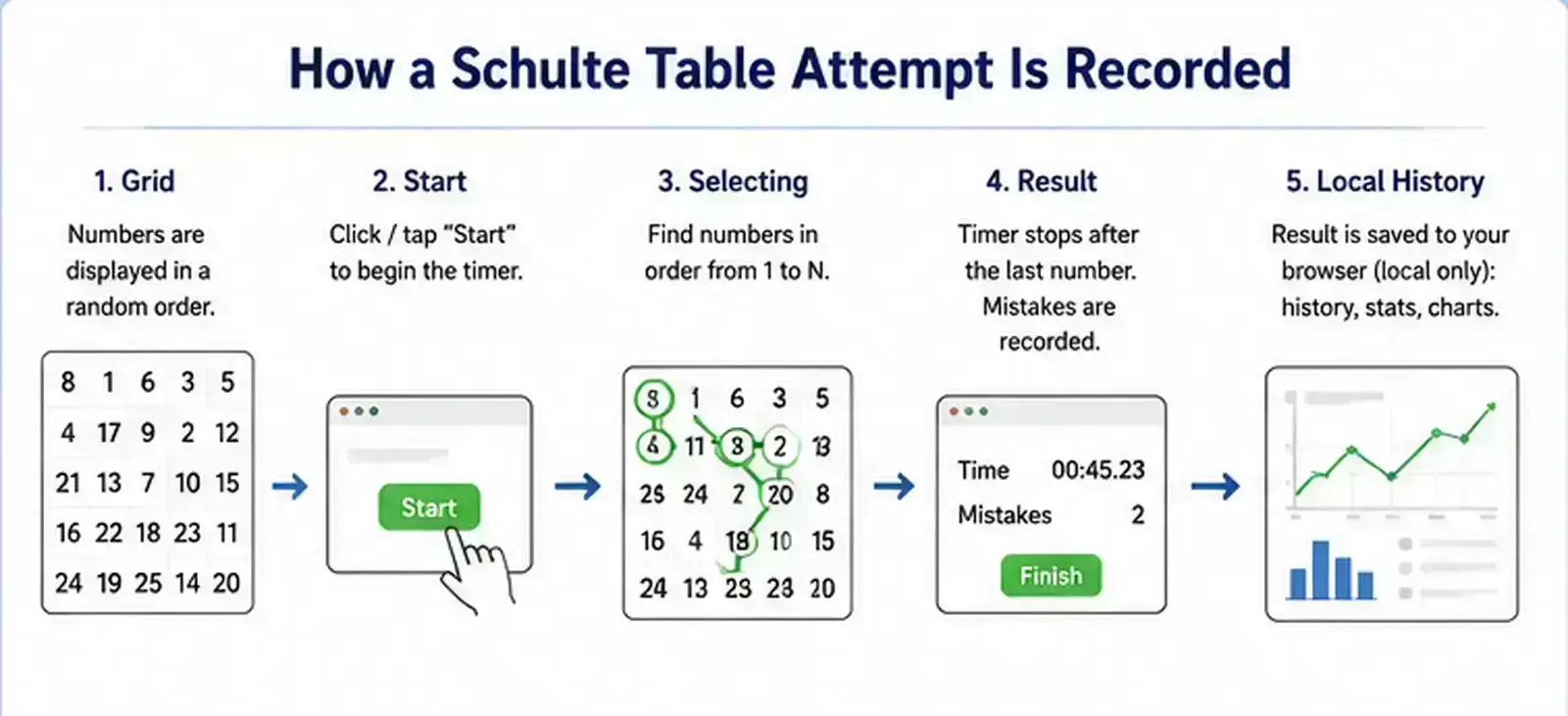
How to Use a Schulte Table
The correct technique makes all the difference. Learn exactly how to use a Schulte Table to maximize your training results.
Step-by-Step Guide
Position Yourself Correctly
Sit at a comfortable distance from your screen — about arm's length. The grid should be fully visible without moving your head. Good posture reduces eye strain during training.
Fix Your Gaze at the Center
Before starting, place your gaze at the center of the grid. This is the most important technique. Your eyes should remain near the center throughout the entire exercise.
Activate Peripheral Vision
With your gaze centered, practice seeing the corners of the grid without moving your eyes. This 'soft focus' or 'defocused gaze' activates peripheral vision. You should be able to see all four corners simultaneously.
Start the Timer and Find Number 1
Click Start and immediately look for number 1 using peripheral vision. Resist the urge to scan the grid. Let your peripheral vision guide you to the number.
Continue in Sequence
After clicking 1, immediately look for 2, then 3, and so on. Keep your gaze near the center between each click. The goal is minimal eye movement.
Review Your Time
After completing the grid, note your time. Compare it to the benchmark table. Don't be discouraged by slow initial times — improvement comes quickly with correct technique.
Practice What You've Learned
Apply the correct technique on the 5×5 grid right now.
Common Mistakes to Avoid
✗ Scanning Row by Row
This is the most common mistake. Systematic scanning is slow and doesn't train peripheral vision. Force yourself to keep your gaze centered.
✗ Moving Your Head
Keep your head still. Only your eyes (and ideally, only minimally) should move during the exercise.
✗ Sharp Focus
Paradoxically, sharp focus reduces peripheral vision effectiveness. Use a soft, slightly defocused gaze for better peripheral awareness.
✗ Rushing and Making Errors
Clicking wrong numbers doesn't help. Accuracy first, then speed. A calm, accurate approach produces faster times than frantic clicking.
✗ Skipping Sizes
Don't jump from 3×3 to 9×9. Progress through sizes gradually. Each size builds the skills needed for the next.
Training Program
Foundation
Practice 3×3 and 4×4 grids. Focus entirely on technique — center gaze, peripheral vision. Don't worry about times. 5 minutes daily.
Standard Training
Move to 5×5. Continue focusing on technique. Begin tracking times. Aim to complete 5×5 in under 90 seconds consistently. 5–10 minutes daily.
Speed Development
Focus on 5×5 speed. Aim for under 60 seconds. Introduce 6×6 for variety. 10 minutes daily.
Advanced Training
Target under 35 seconds on 5×5. Regularly practice 6×6. Introduce 9×9 for endurance. 10–15 minutes daily.
Frequently Asked Questions
How do you use a Schulte Table correctly?
Fix your gaze at the center of the grid. Without moving your eyes, use peripheral vision to locate number 1 and click it. Continue finding numbers in order while keeping your gaze centered. Avoid scanning row by row.
How long should a Schulte Table training session be?
5–10 minutes per day is ideal for most users. This is enough to produce improvement without causing eye fatigue. More experienced users may train for 15–20 minutes.
How many times should I repeat a Schulte Table?
3–5 repetitions per session is typical. Each repetition uses a freshly shuffled grid, so the challenge remains consistent. Focus on quality technique rather than quantity.
What is the correct eye technique for Schulte Tables?
The correct technique is 'soft focus' or 'defocused gaze' — keep your eyes centered on the grid with a slightly relaxed focus. This activates peripheral vision more effectively than sharp focus.
How do I know if I'm using the Schulte Table correctly?
If you're using it correctly, your eyes should barely move during a session. If you find yourself scanning the grid systematically, you're not using peripheral vision effectively. Practice keeping your gaze fixed at the center.